Sunday, 21 January 2018

Representation theory

1) Why is representation an important concept in Media Studies?

Representation is important because it portrays people on what they are like and so if the media portrays people or a group of people in a bad way then it could lead to them people getting stereotyped and not being shown to how they truly are. There is so many cases where this is true but as time go's on some stereotypes on people tend to break.
2) How does the example of Kate Middleton show the way different meanings can be created in the media?

It shows the media uses an image or a story to portray someone in however they want to be in a good light or a bad light and with the Kate Middleton example they could imply if they wanted choose the pictures that made her look bad and use the ones and make it seem like she had a drinking problem. But also if they wanted to make her look good then they could say how respectful and well manured in the way she is drinking the wine making her look good.

3) Summarize the section 'The how, who and why of media representation' in 50 words.

Impacts with representations are considered by producers. They choose the needs of audience, limitations with genre codes. In this process the producers reject and select specific representations, this helps create ideological meaning. These are known as genre codes, which slowly become natural to the audience.

4) How does Stuart Hall's theory of preferred and oppositional readings fit with representation?

This fits into representation because the media can portray a group or a person in a certain way and then you as a consumer of that media can identify what the preferred reading of that portrayed thing is (What everyone is mostly thinking) and what the oppositional reading is (the other side of the argument). 
5) How has new technology changed the way representations are created in the media?

With the rise of new media, audience members can now construct and share their own media products, and in websites, video-sharing platforms and social media there are more opportunities for people to represent themselves than ever before. Individuals can now engage in the act of self-representation, often on a daily basis, through the creation of social media profiles and content. When we post an image on Instagram or some thoughts on Facebook, we are constructing an idea of ourselves, and we are distributing it to our followers or our friends. The choices we make in terms of which images to upload and which comments to create a construction of an idea about ourselves. Social media allow us to construct selective and controlled representations of the public identity we wish to communicate to the world.

6) What example if provided of how national identity is represented in Britain - and how some audiences use social media to challenge this?

The Sun sent a free newspaper to 22 million households in England which represented its own concepts of ‘Englishness’ by symbolic references –queuing, the Sunday roast, Churchill and The Queen – to heroes, values and behaviours that the paper (and its owners, Rupert Murdoch’s News Corps) defined as appropriate expressions of‘English identity’.


Richard Dyer's theory suggests that the complexity and variety of a group is reduced to a few key characteristics. An exaggerated version of these characteristics is then applied to everyone in the group. In this case for taken its the man being strong cool calm and collected. This goes on throughout the whole movie as the main character hero is giving advice and beating up bad guys throughout the film.

Andy Medhurst suggests stereotyping is shorthand for identification. This means we use stereotypes to tell audiences a lot in a short space of time. This is shown in taken when the women gets taken we can see she is the damsel in distress stereotype and that's what we associate with her. And also because the villans are European we instantly tell they are bad guys.

Tessa Perkins suggests some stereotypes can be positive and are often true. Which is represented with the main character being a man he is typically strong and it is true and it makes them out to be in a positive light.

Laura Mulvey suggests that the dominant view in the media is masculine and created for the benefit of men. Women are presented for men to look at, hence the ‘male gaze’. This links to the idea of ‘sex sells’ and women being represented as sex objects. Ans its not typically shown in taken mainly due to the fact that the main character is a older man trying to save his daughter.

Claude Levi-Strauss suggests that representations in the media are informed by ideology: the set of beliefs and values held by the producer of the text. This is shown that the main villains don't get a story on why they are doing what they are doing making them look bad when they might just need the money.


Monday, 15 January 2018

Introduction to Representation


1) List the different people/groups represented in the trailer (men/women/Americans etc.)

Young women, men.

2) For each group you identify, decide whether the representation is a dominant or alternative portrayal. Explain why you think this.

For the young women they are represented to be dominant from the sterotype that young women are helpless and week as from the trailer we see the young girl getting kidnapped and the mother crying through it all not doing anything about it.

For the man its the same as it is dominant as we see him saving the day going through hell to get his daughter back which shoes and reinforces the stereotype that man are stronger then women and get the job done .
3) What stereotypes can you identify in the trailer? 

One stereotype is that the villeins are always foreign as in this film trailer they are in this case. Another stereotype that is present is the fact that women are weak and vulnerable as throughout the whole trailer the mother was crying and the daughter needs to be saved. Lastly the man is strong and takes command as we see the main protagonist save the girl.
4) Why might the Taken trailer offend or alienate certain groups?

The trailer may offend people who are not american as it makes america look like the main top hero and the foreign people in the trailer paints them in a bad light.

5) Why do mainstream film and television texts such as Taken so often use stereotypes?

They tend to do this because they can then attract the viewers who believe in them stereotypes and get more people watching that film or TV show.

Representation catch up work

The front cover of that newspaper make young people seem like criminals and paints them in a bad image as it shows them stealing and also with the hood signalling they are about to do something bad and harm others.

Representation is the process by which the media presents the ‘real world’ to an audience.

Media texts are artificial, constructed versions of reality
Even factual media – such as news – goes through processes of selection, organisation and editing that shapes its content

Groups like women are stereotyped to be weak and helpless while men are strong and always get the job done. And people like young teens are stereotyped to be rude and a danger to society.

I think people stereotype because it satisfies the need to understand and predict the social world. You no longer need to wonder what each individual is like or what he or she is likely to do . All of this is contained in the stereotype.

Social groups could be under-represented or misrepresented because of the media and how they portray weather that be in a bad light.

Media texts are a construction of reality, and play an important role in the way we view the world.

Reality is therefore subject to mediation which is the process that takes place when a media text’s meaning is communicated.

When mediation takes place, an institution, individual or even technology comes between the actual event and the audience.

5 words we associate people with:
• America= Donald trump, Food,patriotism,president,freedom
• Private school students=smart, stuck up, strict,well mannered, rich
• Brexit referendum=Immigration,borders,laws,control,people

Media messages have to be communicated quickly which often means relying on stereotypes. Stereotypes work as a kind of shorthand where a word, image or sound will stand for a lot more.

A stereotype is a standardized, usually oversimplified picture or attitude towards a person, social group, place or event.

Gender stereotypes 
MEN:                                          WOMEN:
strong                                          passive
smart                                           emotional 
active                                           talkative 
tough                                           indecisive 
cruel                                              weak


A representation in the media will either reinforce or challenge the stereotype.

If it reinforces the stereotype, it is a dominant representation.

If it challenges the stereotype, it is an alternative representation.

Friday, 15 December 2017

Industries: Ownership and control blog task

1) Companies Owned by Walt Disney:

ABC Television Group
ESPN, Inc. 
Walt Disney Parks & Resorts U.S., Inc.
Lucasfilm Ltd. 
Marvel Entertainment, LLC.

 2) In my opinion, I think that governments should attempt to prevent conglomerates from being too dominant because the media has an immense amount of power to change and view or opinion of a viewer.

3) Production process: This is done so that the producers know what the audiences wan to see therefore their gratifications.

Distribution process: Using the most convenient way to get the product out to audiences.


Promotion process: This is done to find the target audiences for the product that is being or has been made.


5) Disney- This is a company that is known worldwide for a plethora of reasons consisting of Disneyland, Mickey Mouse, Pixar Movies and owners of companies such as Marvel and lucasfilm.

Marvel- This is a company that is divided in many different types of media with Movies, Comics and Toys. With a joined ownership amongst companies such as Sony, Disney and Fox Marvel is a well known superhero comic company.


Spotify- This company offers a music streaming and downloading service with a pain monthly or annual subscription.


6) Because to so many alternatives to receive media due to the media some legal and illegal the media institutions have reconsidered their business models. For cinemas, they advertise the greatness of IMAX cinema viewing being the ultimate experience of viewing movies which encourages people to go to the cinema. For music due to being able to download so easily the industry has made streaming services that are much easier to access rather than physical alternatives.

7) Examples of technology companies going into the media space are Google and Amazon. With Google owning Youtube and now changing the format of it to have sub platforms such as Youtube Gaming and Youtube RED it shows how they are attempting to make themselves into a media focused company. As for Amazon they are making their Amazon now streaming service as a package with Prime to bring it to the forefront of their company.

8) I do not believe this while some traditional media institutions may be I think the majority of them are actually growing with Cinemas now having record breaking box office movies and the music industry being bigger than ever and with the return of Vinyls it shows the the old can comeback.

Thursday, 14 December 2017

Cultural Industries: blog tasks

1) What does the term 'Cultural Industries' actually refer to?

The term ‘cultural industry’ refers to the creation, production, and distribution of products of a cultural or artistic nature. Cultural industries include television and film production, publishing, music, as well as crafts and design. You might also consider architecture, performance and visual arts, and advertising as part of a cultural industry


2) What does Hesmondhalgh identify regarding the societies in which the cultural industries are highly profitable?

Broadcasting: radio, television (cable, digital and satellite) • Film industries: including the dissemination of film on video/ DVD/ television • Music industries: recording, publishing and live performance • Print and electronic publishing: books, online databases, information services, magazines and newspapers • Video and computer games: or digital games as some commentators refer to them • Advertising, marketing and public relations: greater functional element than other cultural industries; intended to sell and promote other texts; centered on the creation of texts and require work of symbol creators • Web design: high functionality dynamic + strong aesthetic element 


3) Why do some media products offer ideologies that challenge capitalism or inequalities in society?

Some media products offer ideologies that challenge capitalism or inequalities in society because society nowadays in-diverse, the population is a wide spread of different types of people with different types of culture.


4) Look at page 2 of the factsheet. What are the problems that Hesmondhalgh identifies with regards to the cultural industries?

Risky business • Creativity versus commerce • High production costs and low reproduction costs • Semi-public goods; the need to create scarcity

5) Why are so many cultural industries a 'risky business' for the companies involved?

• Risk derives from the fact that audiences use cultural commodities in highly volatile and unpredictable ways – often in order to express the view that they are different from other people. • Risk stems from consumption and is made worse by 2 factors: firstly, limited autonomy granted to symbol creators in the hope that they will create something original and distinctive; secondly, the cultural industry company is reliant on other cultural industry companies to make audiences aware of the existence of a new product or of the uses and pleasure that they might get from experiencing the product. Companies cannot completely control the publicity a product will receive, as judgments and reactions of audiences, critics and journalists etc. cannot accurately be predicted. • Cultural industries can be highly profitable in spite of high levels of risk, but it may be difficult to achieve high levels of profit for independent or individual companies.
6) What is your opinion on the creativity v commerce debate? Should the media be all about profit or are media products a form of artistic expression that play an important role in society?

I think media is an art so it needs to be expressed so people can enjoy it but at the same time needs to appeal to people so they gain money from doing it other wise it would be for nothing.

7) How do cultural industry companies minimise their risks and maximise their profits? (Clue: your work on Industries - Ownership and control will help here) 

Vertical integration-Owning a range of businesses in the same production/distribution.
Horizontal integration-Owning a range of media companies that are largely unrelated.
Integration and Synergy-Series of media products derived from the same text or institution.
Diversification- When a media company branches out into a different area of the industry.
Cross-media regulation-When two companies merge.

8) Do you agree that the way the cultural industries operate reflects the inequalities and injustices of wider society? Should the content creators, the creative minds behind media products, be better rewarded for their work?

I agree with his because they work so hard to get the final product done and not much money for it when in reality they do most of the work and help it come together.

9) Listen and read the transcript to the opening 9 minutes of the Freakonomics podcast - No Hollywood Ending for the Visual-Effects Industry. Why has the visual effects industry suffered despite the huge budgets for most Hollywood movies?


The visual effects industry has suffered despite the huge budgets for most Hollywood movies due to Rhythm and Hughes facing severe financial difficulties.


10) What is commodification? 

When Hesmondhalgh evaluates the changing social significance of the cultural industries, he considers commodification. This involves the transforming of objects and services into commodities. At its most basic level, it involves producing things not only for use, but also for exchange.

11) Do you agree with the argument that while there are a huge number of media texts created, they fail to reflect the diversity of people or opinion in wider society?

I agree to an extent because there are a select few media texts that try to accommodate minority groups however the mass media generally avoid diversity as it tends to be more expense or time consuming to cater to than just generalizing a text or advert to a majority. An example of this is the movie attack the block.

12) How does Hesmondhalgh suggest the cultural industries have changed? Identify the three most significant developments and explain why you thin
#k they are the most important.

Cultural industries are no longer seen as second to the ‘real’economy, ownership and organisation of cultural industries is now much broader, and digitization.

Monday, 11 December 2017

Media regulation: blog task

1) What is regulation and why do media industries need to be regulated?


Very few industries leave the organisations or companies who operate
in that sector to their own devices. Systems of regulation are required
to provide rules and regulations to ensure that organisations operate
fairly.

2) What is OFCOM responsible for?

In the media industry there are several regulatory bodies that exist
to monitor the way that their industries work. Broadcast media (TV
and Radio) are regulated by OFCOM – the OFfice of COMmunication
and the advertising industry is regulated by the Advertising Standards
Authority. So OFCOM make sure media that are okay and sutible for people to see.

3) Look at the section on the OFCOM broadcasting code. Which do you think are the three most important sections of the broadcasting code and why?

Section 1: Protecting the Under-Eighteens. This is due to the fact that kids should not see harmful or sexual scenes at a young age.

Section 2: Harm and Offence. If people watch harmful scenes or violence committed they could be a chance people copy it thinking its okay or if they offend some type of audience then its a lot worse. 

Section 8: Privacy. Revealing someones personal things could get realised which is not good as people would like privacy and somethings too them selves. 

4) Do you agree with OFCOM that Channel 4 was wrong to broadcast 'Wolverine' at 6.55pm on a Sunday evening? Why?


I do think it was wrong as younger audience was probably watching at the time and was able to watch a film which 18+. 

5) List five of the sections in the old Press Complaints Commission's Code of Practice.

Section 1: Accuracy
Section 2: Opportunity to reply
Section 3: Privacy
Section 4: Harassment 
Section 5: Intrusion into grief and shock


6) Why was the Press Complaints Commission criticised?

The lack of statutory powers means that when a newspaper has been found to break the rules, the best a victim can hope for is an apology, which often does not get sufficient prominence in the paper. Critics also argue that many newspapers seem to fly in the face of the rules on a pretty regular basis and that very little is done to stop them.

7) What was the Leveson enquiry and why was it set up?

It was set up as a result of the phone hacking scandal. It was an inquiry into the “culture, practice and ethics of the press”.

8) What was the PCC replaced with in 2014?

On 8th September 2014, the PCC was replaced by the Independent Press Standards Organisation (IPSO).

9) What is your opinion on press regulation? Is a free press an important part of living in a democracy or should newspapers face statutory regulation like TV and radio?

Yes otherwise some things that are said could be twisted and we would need to maintain what is real and fake.

10) Why is the internet so difficult to regulate?

Because everyone can access it and create what they want on it then its harder to keep control on it.

Audience theory

1) Read this Mail Online article about the effects of videogames. How does this article link to the hypodermic needle model?

The hypodermic needle model explains that the media is able to heavily influence the consumers of content that can have long-term effects on the viewers or cause a change the view of certain people.This article supports this as it talks about how violent behaviour is caused by showing young children video games that are not appropriate for their age and will cause them to do violent things.

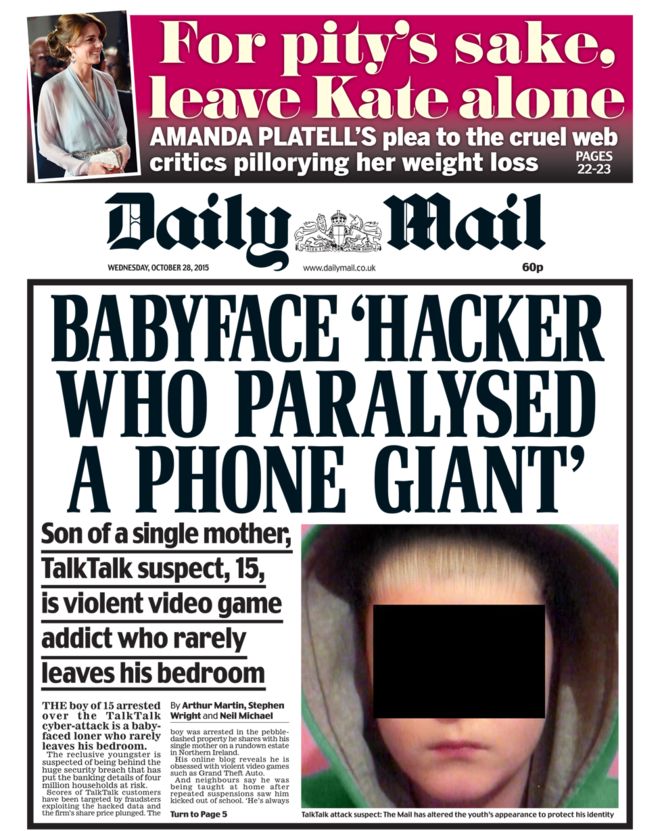
2) How does coverage of the Talk Talk hacking case (see Daily Mail front page below) link to the hypodermic needle model? Why might someone criticise this front page? 


The cover line of the article describes a 15 year-year-old boy as a 'violent video game addict who rarely leaves his room'. This shows how video games has fully taken over his life an does not let no one in on his life.

Two-step flow model

1) Summarise the two-step flow model. In your opinion, is the two-step flow theory still relevant today?

The two-step flow model was developed in the 1940s because the hypodermic needle theory was considered too simplistic, assuming the audience consumed media without thinking.

The two-step flow model instead suggests the audience are influenced by ‘opinion leaders’ in the media who mediate how the audience react to media texts. The theory suggests the media is not all-powerful and that social factors are important. I dont think that this is relevant today as more and more people/younger people have their own opinion.

2) How does this YouTube blogger fit into the two-step flow model?

He gives his opinion on the game and tells his audience if he thinks that the game is good and so when he says he does not enjoy or if he does then people will also follow his lead as he gives the advise not to buy it which shows how people will follow what he says which is relent to the two step model.  

3) How this this Telegraph feature on Britain's most popular tweeters fit the two-step flow model? Do you think these accounts genuinely have an influence over their audience?

This article shows how across so many different forms of media platforms there are multiple opinion leaders with opposing or agreeing to views that affect viewers. To focus on Twitter which is the main source of peoples opinions being shown to the public, tweeters with a large follow base have a lot of power to influence viewers perspectives. With people seeing celebrities as icons/role models people are really likely to influenced by seeing their content showing their power in the two-step flow model.
4) Read this BBC profile of Jamal Edwards. How does Jamal Edwards link to the two-step flow model?

He inspires people to look for their talent which because of the good advice to the people it leads them to follow him in his footsteps to get better. 

1) For each of the four categories, write about one media text that fits that particular audience use or pleasure. Make sure you explain WHY it fits the category and use images or clips to illustrate your points.

Diversion: 
Personal Relationships: 
Personal Identity: 
Surveillance: 


Dependency theory

1) Do you agree that audiences have become dependent on the media? What evidence or examples can you provide to support your view?

I agree that audiences are becoming more dependent on the media as nowadays contacting people, checking news, shopping, or even work are all done due to the meida. Because it is so convenient it is easy to rely on.

2) How has the growth of new and digital technology in the last 15 years changed people's dependency on the media? Is this a new problem?

It has become a problem in terms of becoming addictive to young people, otherwise referred to as 'life consuming' as it is basically impossible to escape from. Also it can be a problem in such a way that actual people aren't needed anymore, for example new technology means that less people are needed to serve customers as there are self checkouts, and less restaurants are needed as there are easier ways to order food these days.

3) Reflecting on your own media use, how does your media consumption impact on your emotions? Does the media have an overall positive or negative impact on your health and wellbeing? Why?

It impacts me because if i hear bad news on the news then i will feel sorry for people and overrule give me a negative mindset and outlook on the world as media only really report on bad news.